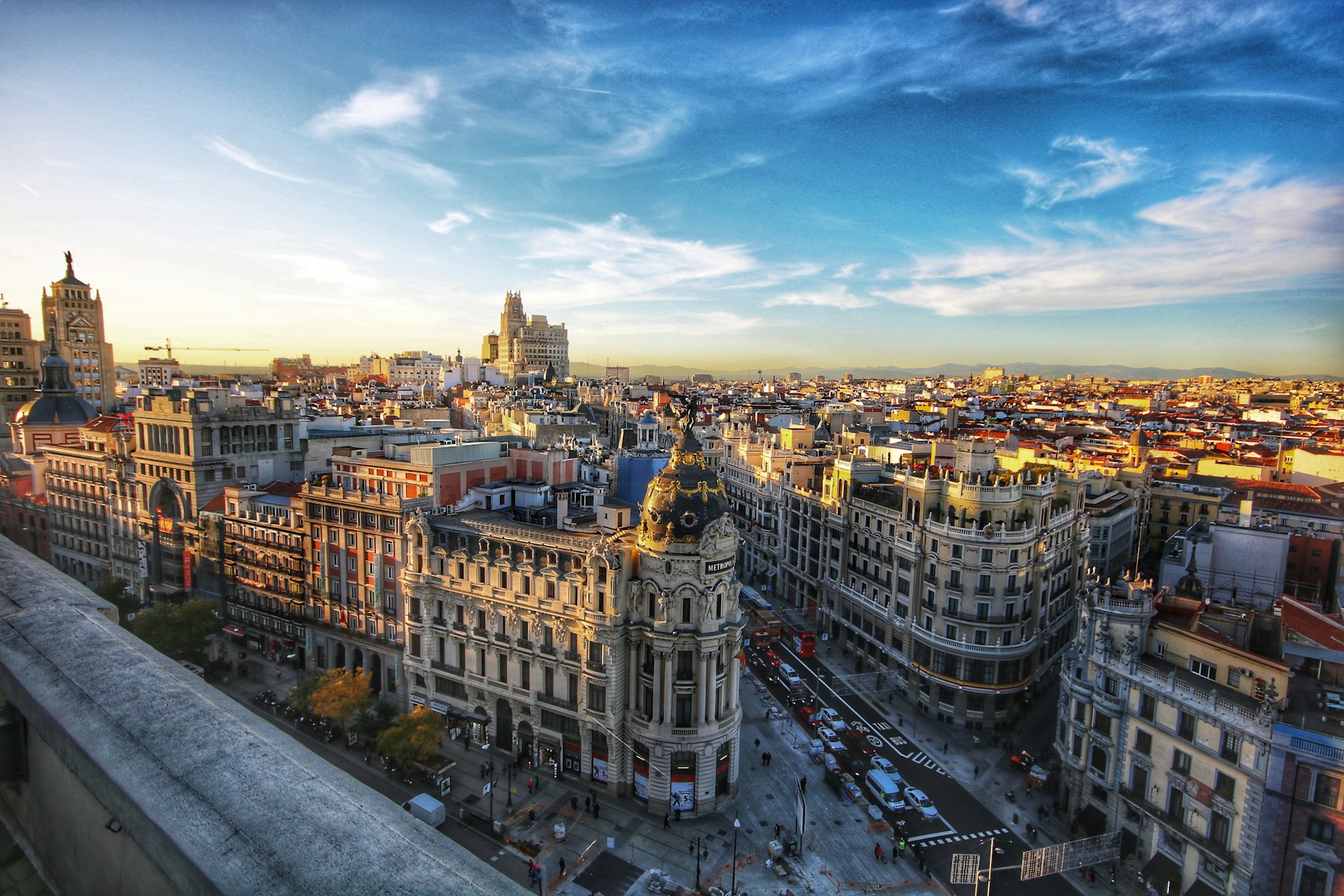
Madrid moves to its own rhythm — the Prado and Reina Sofía anchoring days of extraordinary art, Retiro Park offering a green escape, and a rooftop bar and taberna culture that keeps the city alive long after the rest of Europe has gone to bed.
- Suggested duration: 3–5 days
- Best time to visit: Apr–Jun & Sep–Oct
- Budget: $$$
Madrid is a city that takes time to reveal itself. On the surface it is noisy, confident, and very grand — broad boulevards, Habsburg plazas, ornate 19th-century department stores catching the afternoon light on Gran Vía. But the city's real character lives in its neighbourhood bars, its museum miles, and the particular quality of its nights, which run later and with more conviction than anywhere else on the continent. Come for the Prado. Stay because you can't quite bring yourself to leave.
The Golden Triangle of Art
Madrid's greatest gift to the world is its concentration of major art museums within a single walkable corridor along the Paseo del Prado. The Prado itself — housing Velázquez's Las Meninas, Goya's Black Paintings, Bosch's Garden of Earthly Delights, and rooms upon rooms of Flemish and Italian masters — is arguably the finest collection in Europe and requires multiple visits to begin to absorb. The Reina Sofía, a converted hospital now housing Spain's national collection of modern art, contains Picasso's Guernica alongside works by Dalí, Miró, and the great Spanish avant-garde. The Thyssen-Bornemisza, the third of the trio, fills in the gaps with an extraordinary private collection spanning eight centuries. Budget at minimum two full days for this corridor alone.
Retiro Park and the Old City
The Parque del Buen Retiro — 350 acres of formal gardens, boating lake, glass palace, and rose garden in the heart of the city — provides both a breathing space between museum visits and a destination in its own right. On Sunday mornings, when madrileños take to its paths in force, it offers a vivid window into the city's domestic life. The old city, centred on the Plaza Mayor and the nearby Mercado de San Miguel, rewards slow exploration: the Habsburg and Bourbon quarters layer over each other in narrow streets that lead to unexpected convents, tiled tabernas, and the extraordinary Mercado de San Fernando in Lavapiés.
Eating and the Art of the Taberna
Madrid's food culture is anchored in a set of rituals that have remained essentially unchanged for a century. The vermouth hour — between noon and two — sees neighbourhood bars fill with locals consuming chilled vermut, olives, and anchovies. Lunch, taken seriously at two o'clock, is the main meal; a good menú del día at a neighbourhood restaurant remains one of Europe's great value propositions. Dinner rarely begins before ten. The city's high-end dining has expanded dramatically in recent years, with a new generation of chefs reinterpreting Castilian cooking with contemporary precision. Sobrino de Botín, reputed to be the world's oldest continuously operating restaurant, has served roast suckling pig since 1725.
Neighbourhoods to Know
Beyond the city centre, Madrid rewards exploration of its distinct barrios. Malasaña, once the epicentre of the movida — the cultural explosion that followed Franco's death — remains the most creative and counterculture of the central neighbourhoods, its bars and independent shops occupying beautiful 19th-century buildings. Chueca, to its east, is the city's most welcoming quarter, with excellent restaurants and a terrace culture that spills onto the streets in warm weather. Salamanca, to the north-east, is Madrid's smart address — designer shops, hushed restaurants, and the quiet residential streets where the city's old money has always lived.
When to Go and How to Move
- Spring and autumn offer the most comfortable temperatures (15–22°C) and the finest light for exploring on foot
- Summer brings intense heat (regularly above 35°C in July and August) but also terrace culture, evening concerts, and a city that manages to function beautifully despite the heat
- The Metro is efficient, cheap, and connects all major sights — Line 2 runs the length of the Paseo del Prado
- Walking between the Prado and the Plaza Mayor takes under twenty minutes and passes through some of the finest streetscapes in Europe
Madrid is a city for those who travel with curiosity and without excessive schedule. Its pleasures — a chance discovery in the Prado, a perfect tortilla in a bar that has been there for fifty years, a sunset rooftop over the Gran Vía — reward presence over planning.