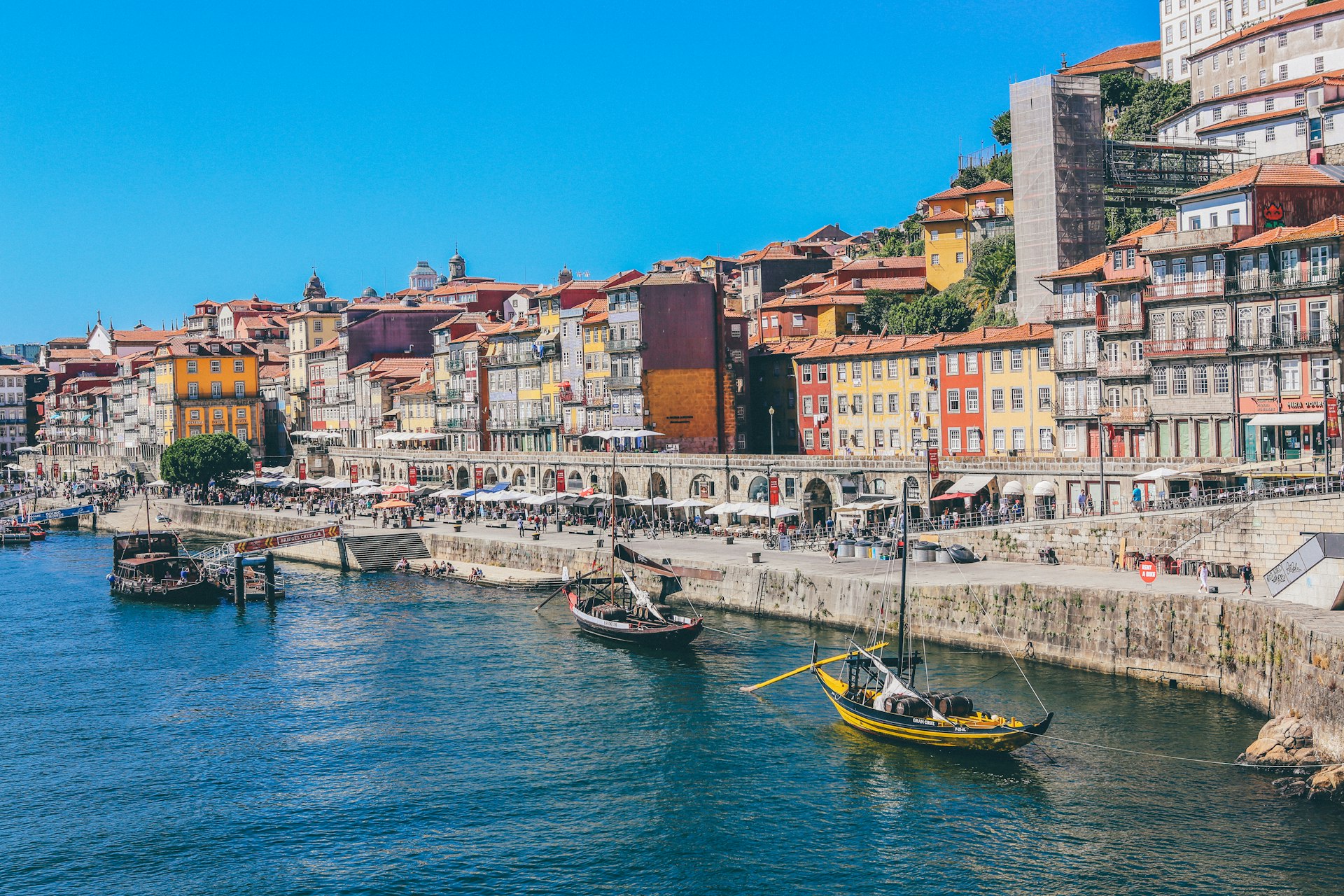
Porto is one of Europe's most beautiful cities — its Ribeira waterfront stacked with ochre and terracotta houses above the Douro, its port wine lodges offering cellar tours of extraordinary depth, and its azulejo-tiled train stations stopping visitors in their tracks.
- Suggested duration: 2–4 days
- Best time to visit: Apr–Jun & Sep–Oct
- Budget: $$
Porto resists easy summation. It is a city of granite churches and baroque azulejo facades, of iron bridges and crumbling grandeur, of a river so wide it seems more like an estuary than a waterway. It is also one of the most architecturally coherent urban landscapes in Europe — a city that feels continuous, that tells its own story in stone and tile, that has not yet been smoothed into the kind of homogeneous attractiveness that ruins so many celebrated places. Come to Porto for the wine, certainly. But stay for the city itself.
The Ribeira and the Douro
The Ribeira — Porto's riverside quarter, UNESCO-listed since 1996 — is the obvious starting point. The narrow streets descending to the waterfront are lined with restaurants serving grilled fish and francesinha (Porto's signature dish: a toasted sandwich of cured meats, sausage, and egg, drowned in a tomato-and-beer sauce of volcanic intensity). The quayside promenade offers one of the finest river views in Europe: the Gaia wine lodges across the water, the Ponte Dom Luís I arching overhead, small rabelo boats — once used to transport port wine barrels from the Douro Valley — bobbing at their moorings.
Port Wine: The Lodges of Vila Nova de Gaia
The port wine lodges of Vila Nova de Gaia, accessible by foot across the lower level of the Dom Luís bridge, are one of Portugal's great hospitality experiences. The major shippers — Graham's, Taylor's, Ramos Pinto, Sandeman — all offer cellar tours and tastings, with options ranging from a basic three-wine flight to an extended masterclass through vintage and aged tawny ports. Graham's Lodge, set on a hillside above the river with a terrace restaurant, is particularly well organised for visitors. A thorough port wine education requires an afternoon, an appetite for tasting, and a willingness to walk back across the bridge slightly unsteadily.
Architecture and Azulejos
Porto's tiled buildings are among the most remarkable in the world. The São Bento railway station — still in daily use — has an entrance hall covered in 20,000 hand-painted azulejo tiles by Jorge Colaço depicting scenes from Portuguese history, completed in 1930. The Igreja de Santo Ildefonso is tiled on its exterior facade in blue and white panels of extraordinary elaborateness. The Livraria Lello, a 1906 bookshop whose interior features a crimson art nouveau staircase and stained glass ceiling, draws queues; arrive early or buy your entry ticket in advance.
Food: Seafood, Pastries, and the Francesinha
Porto's food culture is honest, ingredient-focused, and deeply regional. The bacalhau (salt cod) preparations are some of the most sophisticated in Portugal; the seafood restaurants along the Douro serve whatever came off the boats that morning with minimal intervention. The Mercado do Bolhão, recently restored after years of renovation, is the city's great food market — a two-storey iron-and-glass structure where butchers, fishmongers, cheese sellers, and flower stalls operate as they have since 1914. The pastel de nata and the local pastéis de Tentúgal (a puff pastry filled with egg custard) merit their own itinerary.
Day Trips: The Douro Valley
- The Douro Line railway from Porto's São Bento to Pinhão is one of Europe's most scenic train journeys — three hours of terraced vineyards dropping to the river
- Quinta das Carvalhas and other Douro quintas (wine estates) offer overnight stays with harvest-season experiences in October
- Braga, an hour north, is Portugal's religious capital and home to the extraordinary Bom Jesus do Monte staircase sanctuary
- Guimarães, birthplace of the Portuguese nation, has one of the finest medieval centres in the Iberian Peninsula
Porto is a city that rewards return visits with compounding pleasure. Each neighbourhood — the Bonfim, Miragaia, Foz do Douro at the river's mouth — adds another dimension. It is, by some comfortable margin, Portugal's most underrated major destination.